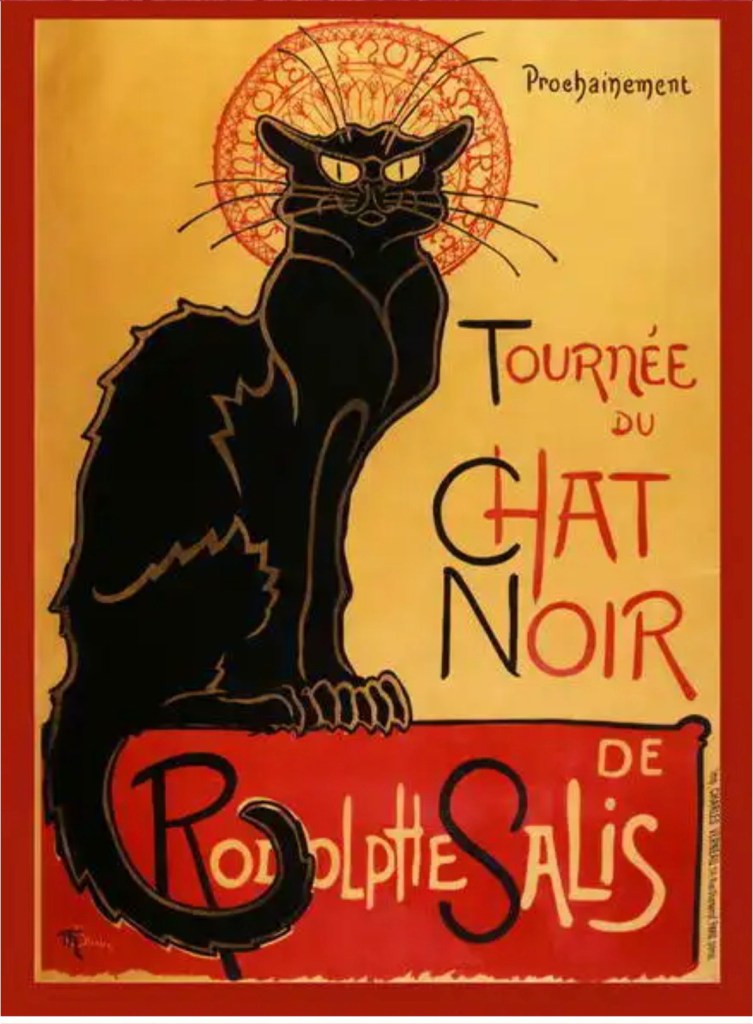


Posters appeal to our subconscious feelings while also stimulating our aesthetic senses and are certainly a reflection of our times, also revealing the origins of their creators.
The ‘art of the poster’, as a concept, offends some people who see it as a lesser form of art. It could be because they are so often mass produced, although certainly not in the case limited edition serigraphy. Perhaps because they are accessible to everyone and not exclusive to wealthy patrons, plays on that way of thinking. I can’t speak for others, I can only relay my personal admiration and love of posters old and new. Even if you think you haven’t been touched and influenced by poster art, I am sure that everyone has to some extent or another.
The modern poster first appeared during the 1840s but the origins are far older. It has been said that prehistoric art such as cave paintings are the earliest examples of what we now call posters.
Lithography, from Greek, lithos meaning stones and graphia to write, is the direct predecessor of the modern poster. Lithography, where artists drew with greasy materials on a stone which was then treated to mark where the water and ink would go was, in its early days, limited to certain colours. Advances in printmaking allowed for it to be mass-produced for advertising.
When Jules Chéret developed a new lithographic process in the 1860s, his ‘three stone lithography’ was more inexpensive to produce and allowed richer and more expressive colours. He was influenced by the new, popular Ukiyo-e Japanese woodblock prints. He started making lithographs and posters accentuating elegant and creative designs. His role in advancing the lithographic process earned him the moniker ‘the father of the Fine Art Poster’. This development, this new lithographic process, made it easier for other artists to adopt the medium and the movement soon flourished.
Jules Chéret was not the only artist experimenting with this art form in Europe. There were many artists before him, as well as his contemporaries experimenting with poster art, including Toulouse-Lautrec and Adolphe Willette. The rising popularity of the poster led to the streets of Paris being filled with posters and colourful advertisements, known as ‘the poor man’s picture gallery’. Furthermore, it was not seen as negative in the art world that the poster had transcended classes. It was no longer exclusive but rather accessible and gave the masses a better appreciation of the arts. This ‘Golden Age of the Poster’ saw the spread of poster art beyond Paris and throughout Europe, with the medium advertising all sorts of things – from cabarets and circuses, to sporting events.
Steinlen’s poster advertisement for the Parisian cabaret Le Chat Noir is an iconic piece of poster art from the movement’s Golden Age. The poster became a more serious form of art by the end of the 19th century during a period called the Belle Époque.
During this time of relative peace and optimism, at the end of the Franco Prussian War, the arts flourished.
Many art movements can trace their origin to this time, such as Art Nouveau, Art Deco, and the beginnings of the Modern contemporary art movement.
The posters produced during this era were in a constant state of evolution and refinement. As with any movement born during the ‘Beautiful Era’, it was defined by its contemporary movements. Poster art was influenced and enhanced by the budding Art Nouveau movement, defining many of the ‘norms’ in the medium such as curvilinear shapes and stylized female figures.
As posters became more popular, they started gaining respect and admiration from European society. The richest families and humble workers found a medium they could both appreciate.
American posters took on a more subtle and realistic approach, with subdued colours and simpler composition. The Illustrator Edward Penfield took to this poster style and his works were well received in Europe where more colourful and extravagant posters dominated.
Propaganda
The assassination of Archduke Franz Ferdinand was the catalyst which started the First World War ned ended what we knew as the ‘Golden Age’.
The poster found a new portal during this turbulent time in the form of war posters. Combatants from both sides utilised the medium as a call to arms.
One of the most iconic posters of this time was Lord Kitchener Wants You by Alfred Leete, exemplifying the true essence of the poster as a medium which spoke directly to its viewer.
In my early twenties I found myself working at the Imperial War Museum in the department of publicity which opened my eyes to many mediums not least of all, the art of the poster. I felt lucky to work in such a place and have access to the department of art where I was able to view all kind of works including those by Paul Nash and John Singer Sargent called upon as artists of their generation to portray the battlefields.
Around about this time I discovered Henri de Toulouse-Lautrec and my love of posters deepened. Posters are sometimes there to sell us dreams or provoke reactions or stimulate nationalism. One thing is sure, without posters our lives would lose colour and my world, at least, would dim.
Posters are currently experiencing a resurgence in popularity, as are various printing techniques such as serigraphy, my latest passion.
I hope that you have enjoyed this post and that you enjoy the beauty and colour which surrounds you, despite the bad news which bombards us.
A bientôt Christina
 MBO Illustrations